Openers · Toronto
Garage Door Opener Diagnosis and Repair
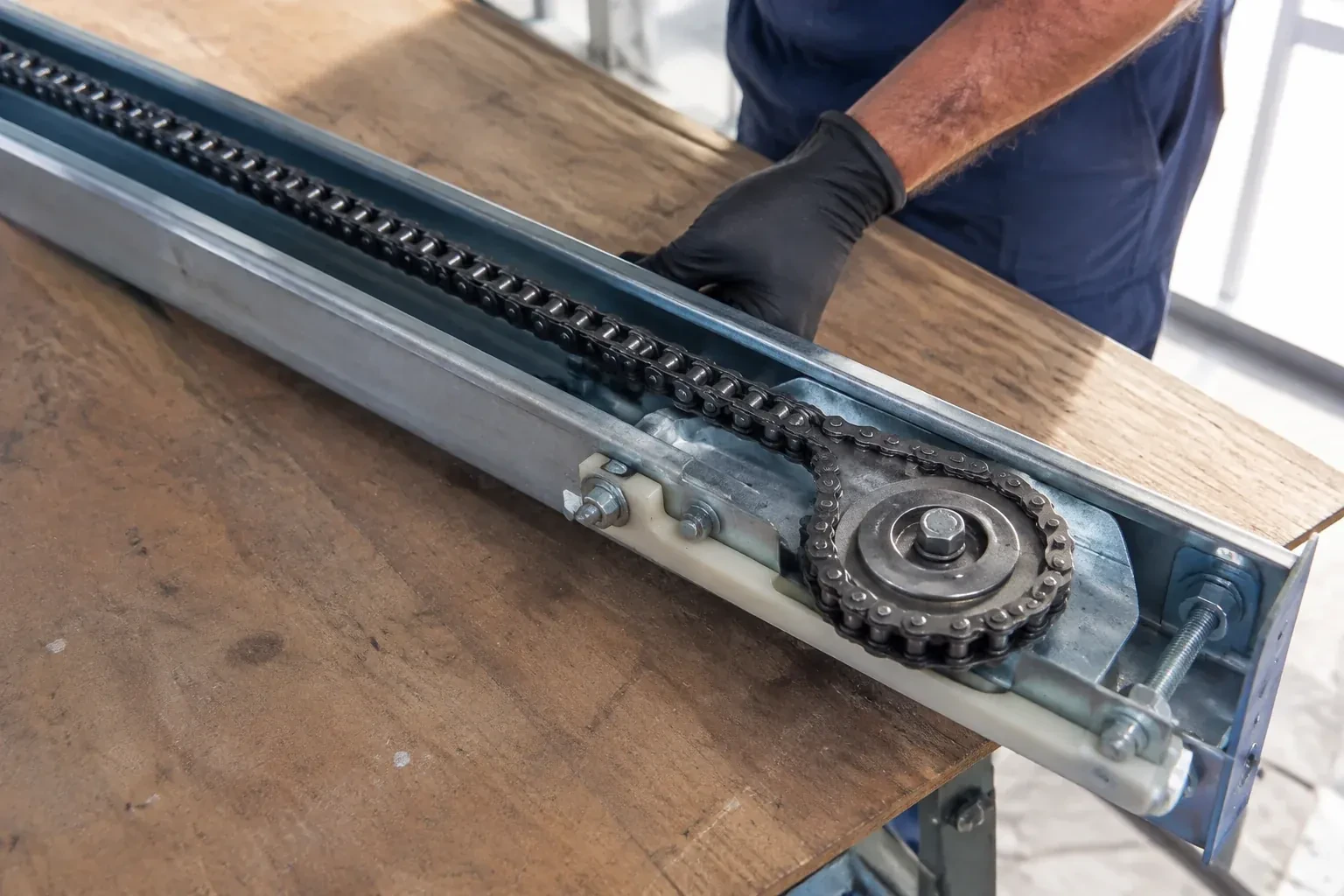
The motor runs, the chain rattles along the rail, and the door does not move a millimetre. You notice the little carriage sliding back and forth on its own.
Garage Door Opener Diagnosis and Repair
In plain words
Every diagnosis ends with the same two tests, because an opener that moves the door is only half fixed. First, a length of 2x4 is laid flat on the floor under the centre of the door and the door is closed onto it; it must reverse on contact and return to fully open. Second, with the door closing, an object is passed through the photo-eye beam near the floor; the door must stop and reverse. These tests are how the opener standard defines a working unit, and they are how the technician proves that the fault found was the fault fixed.
How the visit goesThe door goes up perfectly. Coming down is the trouble: partway to the floor it stops, climbs back to the top, and the light on the opener blinks at you. The only way to close it is to stand inside holding the wall button the whole way down.
Toronto
How the visit goes
Power at the ceiling
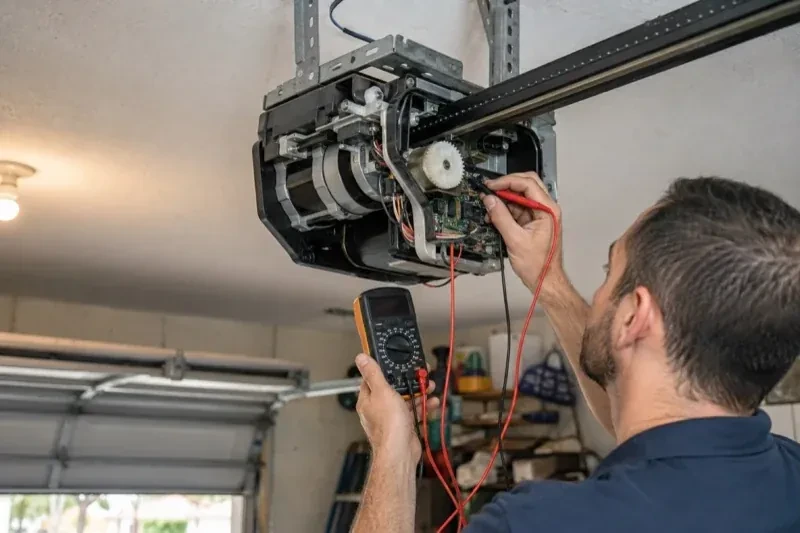
The receptacle above the opener is checked before anything cleverer. A plug can work loose when a car door is slammed underneath it, a breaker or ground-fault device can trip during a storm and stay tripped, and an outlet that shares a circuit with a freezer or a workshop tool may have failed quietly. The technician confirms voltage at the receptacle, watches for the head unit's light and indicator when power is restored, and where the model allows it checks the transformer output and the small fuse on the board. A silent opener is very often an unpowered one, and this step settles that early.
Controls, remotes and programming
Control faults are corrected at the control that failed. A wall console in lock mode is released by holding its lock button until the indicator stops flashing. Remotes get fresh batteries of the type the maker specifies, then are reprogrammed to the head unit with its learn button if the memory was cleared. Range problems are traced to interference, most often from certain LED bulbs in the opener's own sockets, and cured by swapping bulbs or extending the antenna wire. A wall control with a shorted or pinched cable gets new low-voltage wire; a failed receiver or wall control is replaced with one compatible with the opener's frequency and coding.
Care between visits
An opener lasts longer when the door it moves stays easy to move. Twice a year, put a garage door lubricant on the rollers, hinges, bearings and springs; leave the track itself clean and dry so the rollers roll rather than slide. Wipe the sensor lenses and check their brackets have not been knocked. Glance at the chain for slack, and at the bolts holding the rail to the header and the ceiling. Listen for new sounds, since a grinding start or a squeal is the drive asking for attention while the fix is still a small one. None of this touches the springs, which stay a technician's job.
Garage Door Opener Diagnosis and Repair
In the van
- Garage door lubricant
- Photo-eye sensor pair
- Trolley and carriage
- Remote batteries (coin and cylinder cells)
- Bell wire and clips
What affects the quote
Same fees day, night or weekend
1Condition of the mounting
A rail that has sagged, a header bracket pulling out of the wall, or ceiling angle iron that has loosened must be re-secured before the opener is set up, and that hardware work is itemized.
2Remotes and keypads
Each remote or keypad to be reprogrammed, re-batteried or replaced is counted individually. Say how many devices you have so the quote reflects all of them.
3Season and weather
A frozen seal, a stiff door and an unheated garage in the cold months add steps to a diagnosis, such as freeing the door and re-lubricating for low temperatures, and the quote allows for them.
Garage Door Opener Diagnosis and Repair: questions
Will the repair happen during the same visit?
When the cause is a common part carried on the truck, yes: capacitors, gear kits, sensor pairs, trolleys, wall controls, remotes and wiring are typical. When the part is specific to an older model and has to be ordered, or when the diagnosis finds a spring or cable problem that needs its own appointment, the door is left safe and the next step is agreed with you before the technician leaves.
What does an opener diagnosis actually involve?
A fixed sequence of checks, done in order so nothing is assumed. Power at the receptacle. Each control tried on its own. The photo eyes and their indicator lights. The head unit's flash code, if it has one. The drive train from motor to trolley. Then the door itself, disconnected and lifted by hand to test its balance. Only after that is a part named and, where it is a small one, replaced during the same visit.
The wall button works but none of my remotes do. What happened?
Three things account for most of these. The wall control has been put into lock mode, sometimes by a child or a visitor, which blocks all remotes until it is released. The opener's memory was cleared, usually by someone pressing the learn button while trying to program a new remote, so every remote needs programming again. Or the receiver in the head unit has failed. The first two are simple settings; the third is a part.
Openers & Access
Garage Door Opener Diagnosis and Repair near you
Residential and commercial customers in Toronto come to us for spring and cable replacement, off-track resets, opener diagnosis and replacement, remote and keypad programming, weatherstrip and seal work, balance adjustments, panel repair and new door installation. Each service is explained on its own page in plain language.