Openers · Centennial
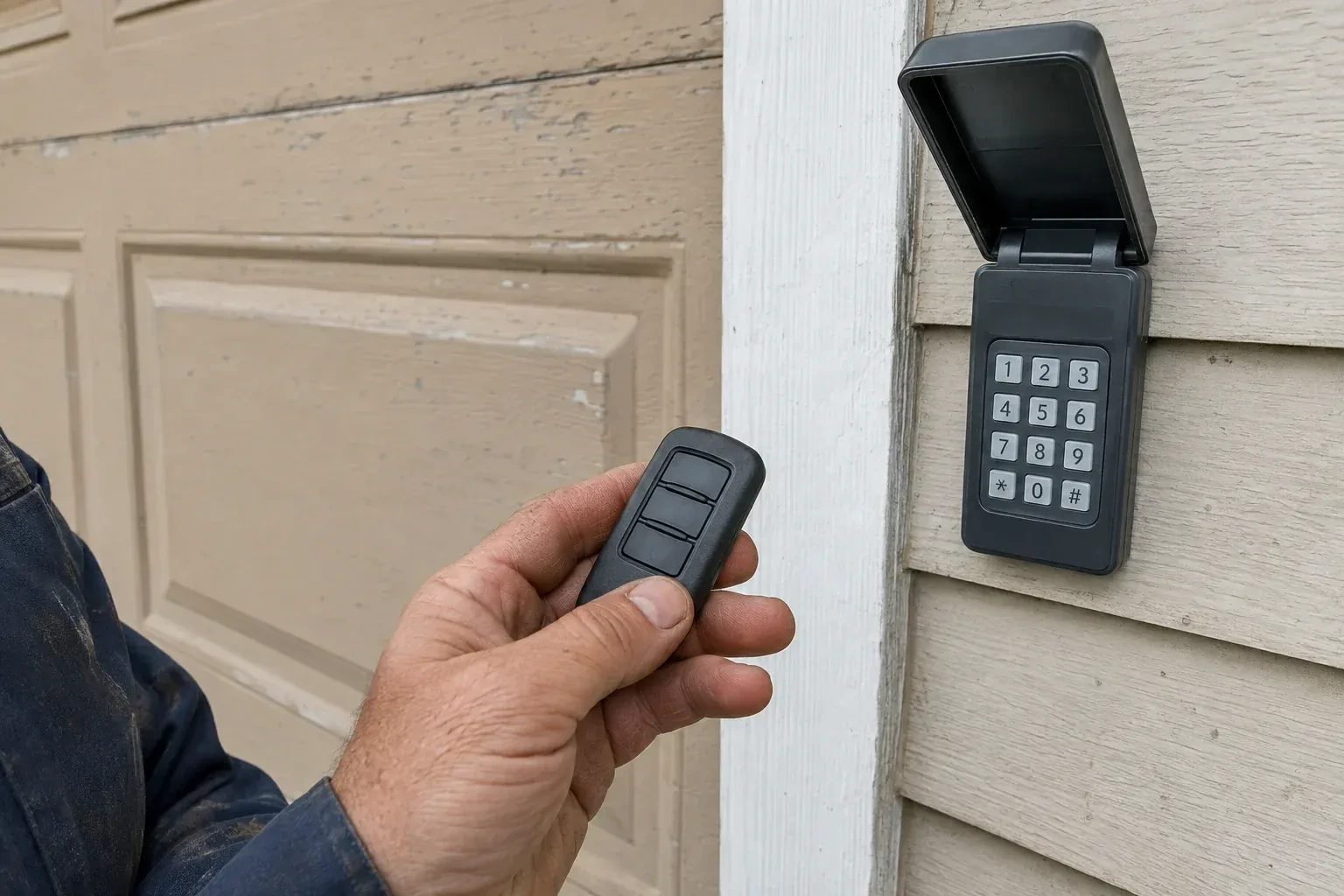
Garage Door Remote and Keypad Programming in Centennial
The new car has three buttons in the mirror for garage doors. You held the old remote up to it as the manual said, the light in the car changed, and yet the door ignores it completely.
Garage Door Remote and Keypad Programming
In plain words
Most remotes that refuse to pair were never going to. Garage door openers have gone through several radio generations since the mid-1990s, and a remote made for one generation is invisible to a receiver from another. The learn button on the head unit, its colour on many makes, and the model label tell the technician which generation you have. The right remote or keypad is chosen from the maker's compatibility chart before any packaging is opened, or a universal control that speaks several generations is used. Programming then takes a moment, because the two sides can finally hear each other.
How the visit goesThe new car has three buttons in the mirror for garage doors. You held the old remote up to it as the manual said, the light in the car changed, and yet the door ignores it completely. The handheld remote works fine.
Centennial
How the visit goes
One control or all of them?
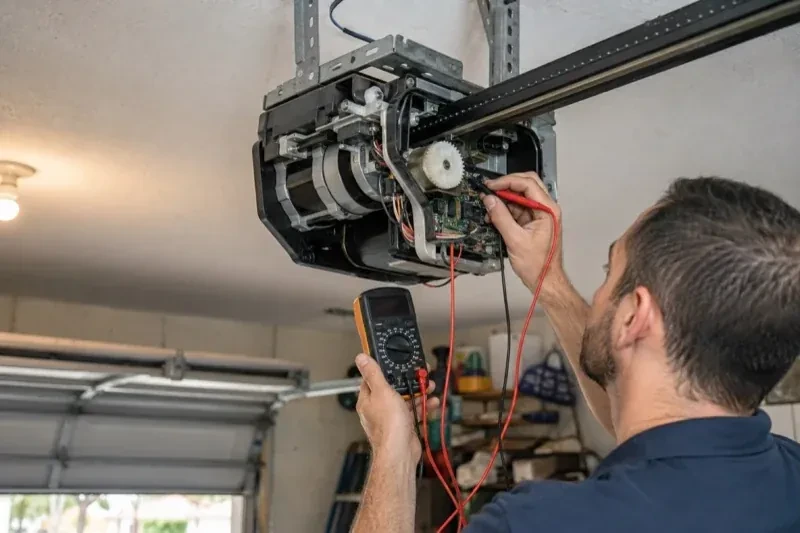
The pattern of failure points to the cause. When a single remote has gone quiet and the rest work, the trouble is inside that remote: a flat cell, corroded contacts, a worn button or a lost pairing. When every wireless control fails together while the wall button works, the technician looks at the opener's side: lock mode, a cleared memory, an antenna pushed into the housing, interference from bulbs, or a receiver that has stopped listening. A known-good remote from the truck is tried against the unit to settle the question. Sorting this early keeps the fix aimed at the right end of the radio link.
Training the buttons in the car
A vehicle's built-in garage button often learns in two stages on rolling-code openers. First the car learns the remote: with the handheld remote carrying a fresh cell held close to the mirror or console, the vehicle button and the remote button are pressed together until the indicator changes. Second, the opener learns the car: the technician presses the head unit's learn button and returns to the vehicle inside the window that follows to press the trained button until the door moves. Some vehicle systems follow a different sequence with no handheld remote, so the vehicle and opener instructions are checked first. Where an older in-car system cannot hear a newer opener, a small bridge module is added.
Every control tested in your hand
Before the technician leaves you operate each device yourself: the remote from each car, the keypad with your new code, the vehicle button from the driver's seat, the wall control. You see the door open fully and close to a gentle seal from each one. If a remote has two or three buttons, you know which door or gate each drives, and a small label says so. You also watch the reversal tests performed, so you know the door backs off an obstruction and stops for the sensor beam. Nothing is left as something to try later on your own.
Garage Door Remote and Keypad Programming
In the van
- Wireless outdoor keypad
- Receiver transformer and two-conductor wire
- In-vehicle compatibility bridge module
- AAA and nine-volt keypad batteries
- Add-on rolling-code receiver kit
What affects the quote
Same fees day, night or weekend
1Range and interference work
Swapping bulbs, freeing the antenna and re-testing range from the street is a small addition when remotes work only up close.
2Shared or managed building
In a condominium or rental building, coordinating with the property manager and working on a common door adds steps to the visit.
3Keypad supplied or existing
Programming a keypad already on the wall is one task. Supplying and mounting a new one, including anchors for brick or siding, is a larger item.
Garage Door Remote and Keypad Programming: questions
Is the door tested for safety after programming?
Yes, every time. Each new control is operated while the technician watches the door's full travel, then a 2x4 is laid flat under the door and the door must climb back up on touching it, and a broom handle passed through the photo-eye beam during a second close must stop and reverse the door. A remote is a way of moving a heavy door, so the visit ends only when both tests pass.
How many remotes can one opener store?
It depends on the unit. Older head units and add-on receivers hold a handful of devices, often fewer than ten, while newer openers store dozens of remotes, keypad codes and vehicle buttons. When a memory is full, the oldest entry may be overwritten or the new device refused. Taking stock of which controls are still in use, and clearing the ones that are not, keeps space for the devices that matter.
What should I gather before the technician arrives?
Every remote you own, working or not, and the keypad if it has been taken down. The opener's model label or a photo of the learn button under the light cover. The cars whose buttons need training, parked close to the door. A note of who should have access and whether any remote is missing. A code in mind for the keypad. All of this shortens the visit and makes the handover complete.
Openers & Access
Garage Door Remote and Keypad Programming near you
Households in Centennial mostly need three things from us over the life of a door: a tune-up now and then, a spring or cable when one lets go, and a new opener or door when the old one is finished. Every one of those, plus the smaller jobs between, is covered below.