New Doors · Centennial
Wind-Rated Garage Door Replacement in Centennial
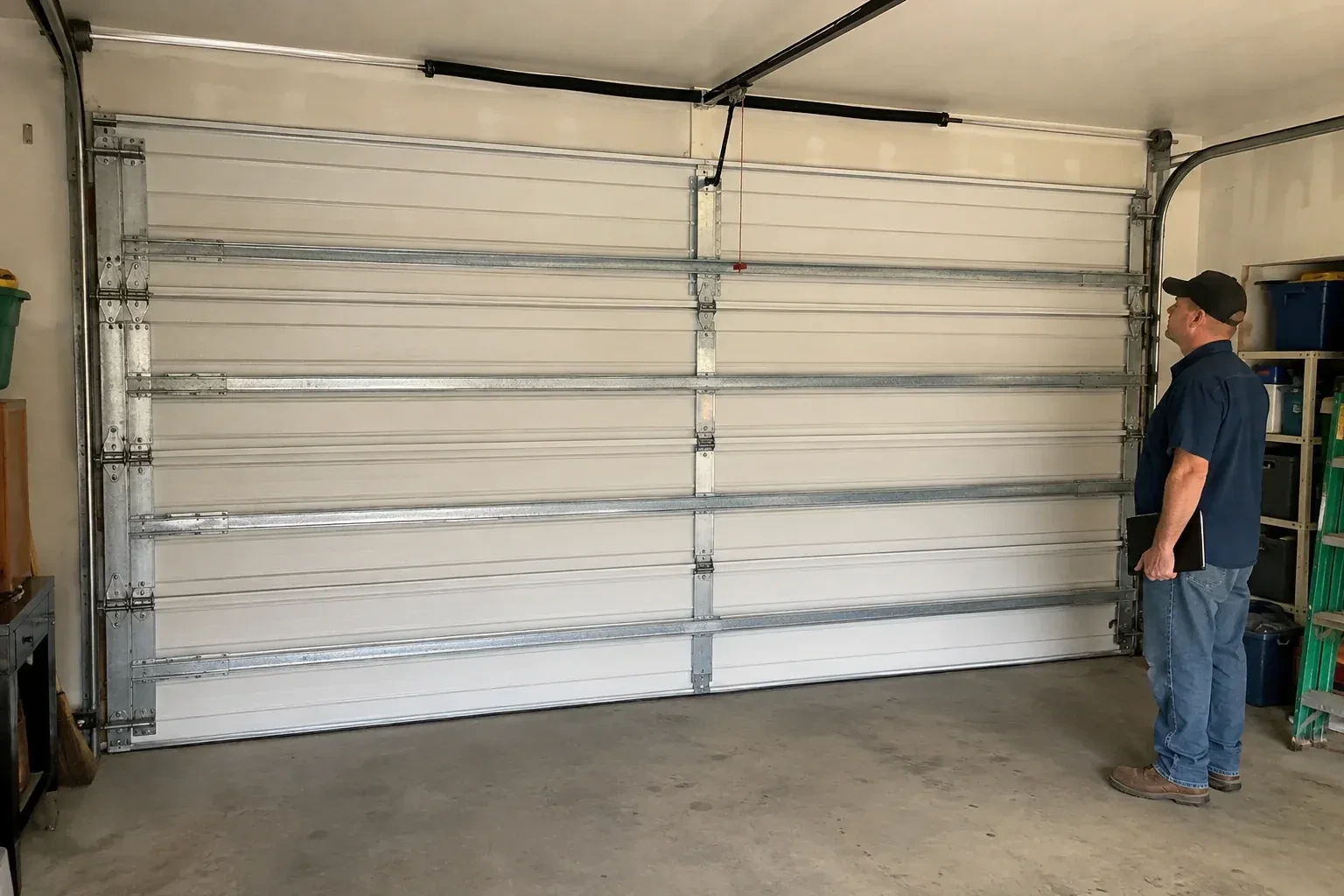
The current double door shudders when pressure changes outside, and daylight appears briefly along one edge. Its tracks are light, the jamb material is aging, and no one knows which reinforcement was originally specified.
Wind-Rated Garage Door Replacement
In plain words
Changing from two single doors to one double door affects more than curb appeal. The broader span changes how the door bends under pressure and how forces reach the side jambs. Replacement planning therefore starts with the new finished dimensions, structural framing, required design pressure, headroom, and operator location. A matching reinforced door package is then installed with its specified track and attachment details. Springs are sized for the finished weight, seals are set against the opening, and the operating system is tested after the conversion work is complete.
How the visit goesYou are combining two narrow garage bays into one broad opening. The new door spans much farther than either old door, bringing section reinforcement, track strength, jamb attachment, and design pressure into the planning conversation.
Centennial
How the visit goes
Measure the full opening
The first survey records finished width and height at several points, plus sideroom, headroom, backroom, floor slope, and ceiling obstructions. A wide door must fit its documented size range, and small variations in an older opening can affect track position or seal contact. The technician also notes whether the jambs are plumb, the header is level, and the floor rises near either corner. These measurements define the usable opening before any door style, window arrangement, or reinforcement package is chosen.
Set tracks and attachments
Vertical tracks are positioned to the specified spacing and secured with the brackets and anchors called for by the selected configuration. Flag brackets, horizontal tracks, rear supports, and any heavier-gauge members are assembled square to the opening. Fastener type, embedment, edge distance, and spacing follow the installation details for the mounting material. Both sides are checked together so the reinforced door has room to travel freely while its hardware remains firmly connected when wind pressure acts across the closed sections.
Compatible parts in future service
When a roller, hinge, bracket, strut, track piece, or section eventually needs attention, the existing part is matched against the door documentation rather than selected by appearance. Thickness, material strength, hole pattern, roller stem length, and fastener location may be significant even when two pieces look alike. Sharing the installation record at the start of a service visit keeps the repair tied to the intended assembly. It also reduces guesswork around the heavier hardware often used on a wind-rated configuration.
Wind-Rated Garage Door Replacement
In the van
- Lift cables and drums
- Operator reinforcement bracket
- Winding bars and levels
- Reinforced end hinges
- Jamb and flag brackets
What affects the quote
Same fees day, night or weekend
1Required design pressure
The project's inward and outward pressure criteria shape which complete door assemblies are suitable, including their reinforcement, tracks, hardware, and attachment details.
2Reinforcement arrangement
The number and type of horizontal struts, operator reinforcement, and any vertical post system follow the selected size and pressure configuration.
3Supporting wall material
Wood framing, masonry, concrete, and steel call for different anchors, tools, embedment details, edge clearances, and installation methods at the jambs.
Wind-Rated Garage Door Replacement: questions
What should I watch for during strong winds?
During strong or severe winds, shelter in a basement or small interior room away from windows, doors and exterior walls, rather than watching the door while it blows. Once conditions have passed, look over the opening: note unusual bowing, new creases, displaced rollers, loose attachments, perimeter gaps, or movement at brackets and jambs, and let these details guide a later assessment.
How is the new door tested after installation?
Technicians cycle it by hand to assess balance, cable tracking, roller travel, clearances, and seal contact. After the operator is connected, they set the open and close limits, confirm the manual release, interrupt the photoelectric beam, and conduct the prescribed contact-reversal check. Hardware and reinforcement receive a final visual review with the door closed and raised.
Why are both positive and negative pressures important?
Wind can push a closed door toward the garage or create suction that draws it outward. Those actions load sections and hardware differently, including rollers, hinges, tracks, and attachments at the jambs. A suitable configuration addresses both directions using the pressure values and details established for the project rather than treating reinforcement as resistance in only one direction.
Installation & Upgrades
- Insulated Steel Garage Door InstallationYou want windows for natural light without turning the garage into a cold glass wall.
- Carriage-House Garage Door InstallationYou appreciate the grain and depth of traditional wood doors, though regular refinishing is not…
- Full-View Glass Garage Door InstallationThe garage works as a studio during the day, yet the closed solid door leaves it dependent on…
Wind-Rated Garage Door Replacement near you
Households in Centennial mostly need three things from us over the life of a door: a tune-up now and then, a spring or cable when one lets go, and a new opener or door when the old one is finished. Every one of those, plus the smaller jobs between, is covered below.